
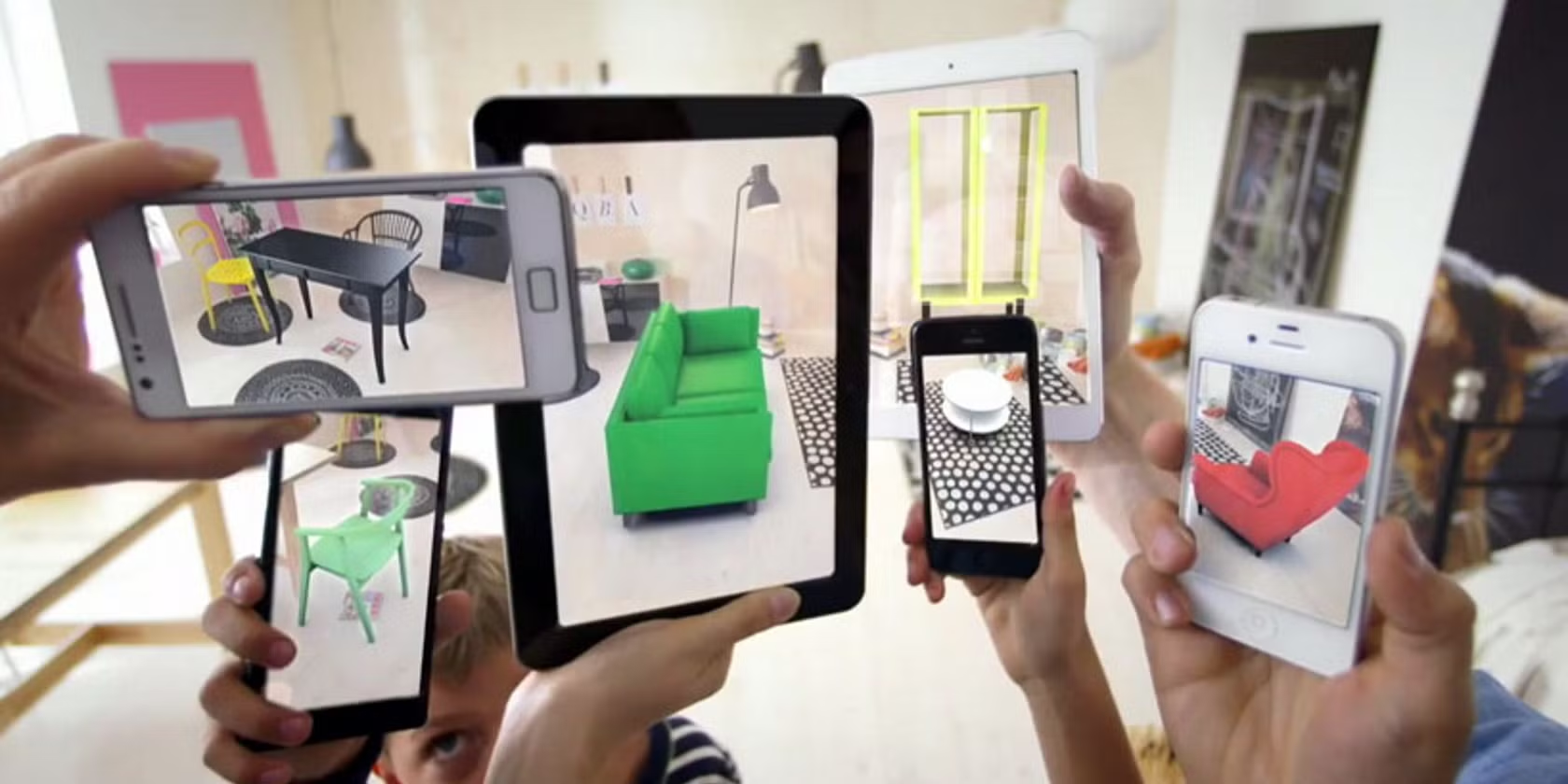
Augmented reality (AR) is rapidly changing the way people interact with digital content by overlaying computer-generated information onto the real world. Unlike virtual reality, which immerses users in fully digital environments, AR enhances the physical world by adding visual, audio, or interactive elements. This technology has found applications across gaming, education, retail, healthcare, and industrial sectors, creating more engaging, efficient, and interactive experiences. As AR technology becomes more advanced and accessible, its potential impact on daily life and business continues to expand.
One of the most prominent applications of AR is in gaming and entertainment. Popular mobile games, such as those developed by Niantic, overlay digital objects onto real-world locations, encouraging players to explore their surroundings while interacting with virtual elements. AR technology also enhances live events and performances, adding immersive visual effects and interactive features. This creates new forms of entertainment where users can experience digital content without leaving the physical world.
In education, AR provides innovative opportunities for interactive learning. Students can use AR-enabled devices to visualize complex concepts, conduct virtual experiments, or explore historical sites and scientific models in three dimensions. AR enhances understanding and retention by making abstract ideas tangible and engaging. Institutions are increasingly incorporating AR into classrooms to create dynamic and immersive educational experiences that cater to diverse learning styles.
Retail is another industry benefiting from AR technology. AR applications allow customers to virtually try on clothes, accessories, or makeup before making a purchase, reducing uncertainty and improving satisfaction. Furniture and home decor companies, such as IKEA, have implemented AR apps that let customers visualize how products will look in their homes. This not only enhances the shopping experience but also reduces return rates and improves consumer confidence.
Healthcare applications of AR are transforming medical training, diagnostics, and surgery. Surgeons can use AR to overlay imaging data, such as CT scans or MRI results, onto a patient’s body during procedures, increasing precision and reducing risk. Medical students can practice surgeries in simulated AR environments, gaining hands-on experience without endangering patients. AR also aids patient education by helping individuals visualize treatment plans or understand complex medical conditions more clearly.
Industrial sectors are leveraging AR to improve operational efficiency and safety. Maintenance and repair personnel can access AR-guided instructions overlaid on machinery, reducing errors and training time. AR can also assist in design and prototyping by visualizing concepts in three-dimensional space before committing to production. Companies such as Boeing have successfully used AR to enhance assembly processes, improving accuracy and reducing time spent on complex tasks.
Despite its growing applications, AR faces several challenges. High development costs and technical limitations, such as battery life, processing power, and display quality, can hinder widespread adoption. Ensuring accurate alignment of digital overlays with real-world objects is also critical for maintaining immersion and usability. Privacy and security concerns arise when AR devices collect and process environmental or user data, requiring careful attention to regulations and ethical considerations.
As AR technology evolves, integration with artificial intelligence, 5G networks, and wearable devices is expected to enhance its capabilities further. AI can enable more intelligent object recognition and adaptive interactions, while high-speed connectivity allows real-time data processing for more seamless experiences. Lightweight, ergonomic AR glasses and headsets will make the technology more practical for everyday use, expanding its reach across industries and personal applications.
The future of AR is poised to redefine the boundaries between the digital and physical worlds. As adoption grows, it will influence education, entertainment, commerce, healthcare, and industrial operations, creating interactive and efficient solutions. Businesses that leverage AR effectively can improve customer engagement, streamline workflows, and foster innovation.
In conclusion, augmented reality is transforming how people interact with the world by overlaying digital content onto the physical environment. Its applications span gaming, education, retail, healthcare, and industry, enhancing engagement, efficiency, and understanding. While challenges related to cost, technology, and privacy remain, AR’s potential to reshape everyday experiences and business operations is immense. As the technology continues to advance, augmented reality will play an increasingly significant role in the digital landscape.








Leave a Reply